
This article was written for and first appeared in Dissonant Times. You can read it in print and online there—and here!
The University of Oregon is looking down the barrel of a $63.3 million budget deficit this fall. Phil Knight recently donated a record-breaking $1 billion to finance a new engineering college, and none of his money will go toward the structural deficit—which is the bulwark to a sinking ship of layoffs, program consolidations and overall fiscal chaos at the university.
Though seemingly contradictory, this moment has been decades in the making.

Tax revolt, neoliberal dreams
Conservative and corporate interests advanced wealth accumulation in the early 1990s, marking the start of the university’s “neoliberal turn.” Put simply, neoliberalism refers to a “free-market” capitalism—turning assets away from public funding and toward private backing—disempowering democratic systems subject (in theory) to checks and balances.
By the turn of the century, new property tax laws won through Ballot Measure 5 by conservative, anti-tax political actors limited UO’s state funding to less than a quarter of its general budget—a nearly 40 percent reduction from years previous.
Tuition rose 72 percent at UO, forced by five years of Measure 5 cuts. It increased sharply each year, tripling the cost of attendance from 1990 to 2026: instate students went from paying $5,400 to $14,500, and $15,500 to $44,500 for students out of state.
While students suffered the reality of higher education’s public-to-private cost burden—where, today, U.S. student loan debt totals over $1.7 trillion—wealthy Oregonians enjoyed some two dozen different tax breaks in the following decades, shifting student demographics toward those with the means to pay out-of-pocket.
Tuition increases accounted for general funding withdrawn by the state, but UO still needed funding for capital projects like remodeling and expanding campus buildings. University administrators began emphasizing the need for “strategic partnerships” with industry and wealthy alumni to keep the school afloat.
Uncle Phil steps onto the court
One businessman and UO alum in particular—Nike co-founder Phil Knight—seemed like a prime donor to court. In a sea of chaos, Nike rode the highest wave, surpassing $2 billion in annual sales.
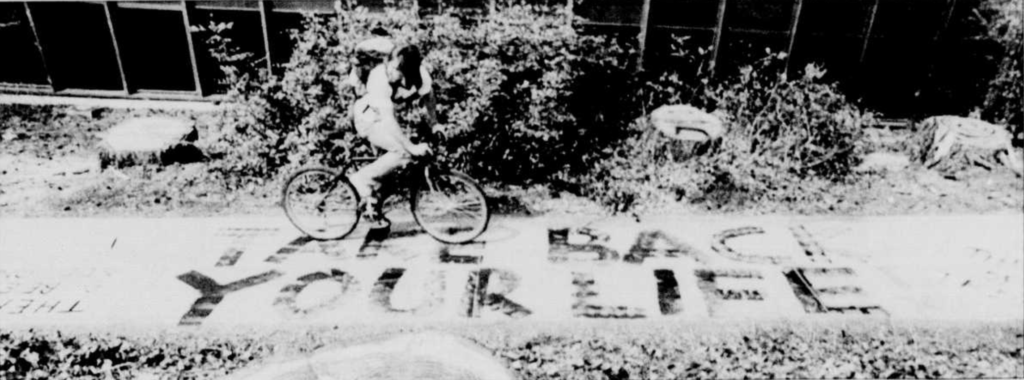
Knight’s first major donation to the school came in 1994: making the lead gift in a $27.2 million renovation and expansion of the rechristened “Knight” Library. Students protested the removal of old growth trees to make way for the renovation, but were unsuccessful.
In the following decade, the university removed a number of family housing units occupied by low-income students from the East Campus area. When MacArthur Court started to show its age, the UO further cleared the area for a new indoor sports arena—and in exchange for $100 million, they named it after the Knight family, too.
In 2022, nearly half of the school’s Urban Farm was destroyed against student and community wishes in order to make room for the Knight Campus for Accelerating Scientific Impact, which was bankrolled by two $500 million gifts from Penny and Phil Knight.

Knight’s gradual creep into university finances eventually coheres a clear pattern: administration courts a large “gift” from Knight to fund a project that, on its face, may be a welcome improvement for the institution, but on the ground, is at odds with interests of the students, workers and community with actual stake in the institution.
But all that is just what UO signed up for in their solution to pulled state funding; relying on private interests means you have to carry out their will once they’ve signed the check—without any built-in accountability apparatus.
Even more, you have to deal with donors’ strange and often wicked behavior.
In early 2000, a student encampment pressured UO President Dave Frohnmayer to sign the university into an agreement with an organization that would monitor the working conditions of the university’s apparel supply chain… including Nike. Knight was incensed—his empire, threatened by his own charity project! He retracted a $30 million pledge for a renovation to Autzen Stadium, but that wasn’t enough. He needed to play dirty.
President Frohnmayer’s three daughters suffered from Fanconi Anemia—a terminal genetic disorder without a cure—and he operated a research foundation as his best shot at extending their lives. Knight was an annual donor of $1 million, but in his rage, he informed Frohnmayer he would not be making his contribution when Christmas came around that year.
This inspired Frohnmayer to quickly find a legal pathway out of affiliation with the more radical Workers Rights Consortium, and Knight reinstated both the $30 million pledge and upped his donation to $2 million for the Fanconi Fund. Frohnmayer’s daughters all died from the disease before reaching the age of 30.
In 2011, Knight formalized his spot in the chain of command, teaming up with other billionaires to dismantle the state’s higher education governance system. Their pitch to create more localized control for each of the state’s seven public universities was a smoke screen for a vicious and exclusionary structure: the Board of Trustees.
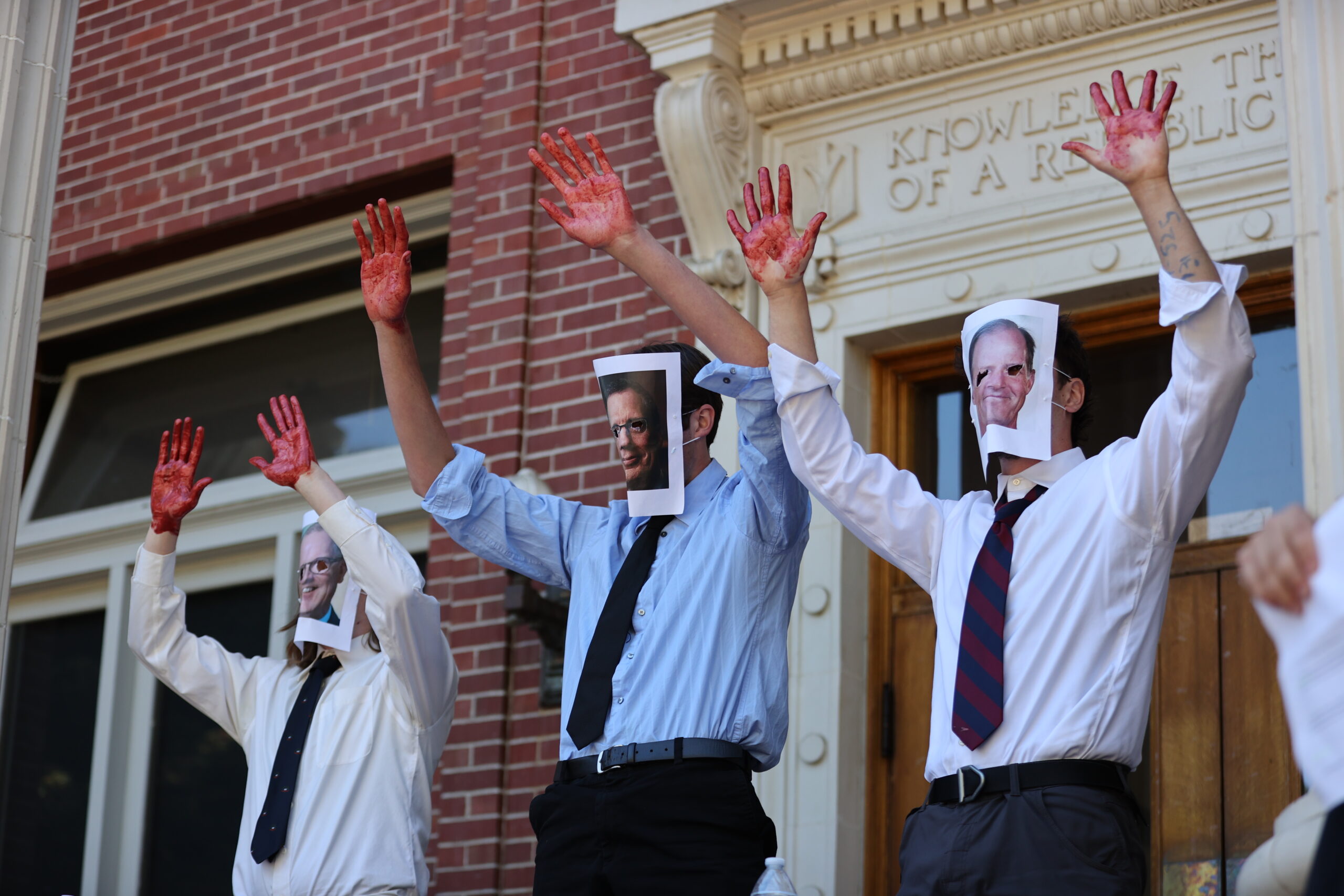
Each school now has its own board that makes its own rules instead of relying on a statewide body that is subject to state law. However, members are not democratically appointed, but nominated by the university president—who is hired by the board: a circular system without meaningful input from students, workers or community. Today, UO’s board includes career executives, hedge fund managers and a billionaire with heavy ties to the fossil fuel industry.
Knight’s philanthropy at the UO has earned him an estimated hundreds of millions dollars in tax breaks, incessant positive media exposure and many an exclusive brand deal for Nike.
And now—this September, Knight made his biggest move yet, donating a $1 billion sum to establish a new college of engineering that will operate out of the Knight Campus. Deemed the largest donation ever to a comprehensive public university, Knight’s gift shapes the school’s academic direction towards a “Silicon Forest”: The Knight School of Engineering will offer elite scientific education for “high demand disciplines,” including AI development, finite resource extraction, semiconductors and geoengineering.
Knight’s long con at UO is paying off in full grandeur. Yes, the school will certainly train students who make contributions to less sinister ends, but its development aligns with the technofascist takeover underscored by local struggles against data centers, surveillance technologies and environmental destruction.

Enter: the for-profit public university
Last week, UO’s revised proposal to address the $63.3 million structural deficit placed cuts to academics at $25.8 million, over 40 percent of the total deficit.
If the proposal goes through, UO will join three other states without a doctorate history program and kill “one of North America’s few graduate (folklore) programs”—among countless other compounding ramifications in the humanities, education, music, design and journalism departments.
Graduate employees will suffer the brunt of workforce reductions, although faculty’s uproar last year seems to have saved tenure track positions from elimination—for now. What’s for certain is that undergraduate students will be without the support of brilliant graduate students, and the next generation of scholars in these fields will be thinner.
Many students, organizations and outlets have pointed out the obvious irony between the timing of Knight’s latest donation and the proposed cuts: why can’t a small portion of the gift be used to balance the deficit? It would only take 6.5 percent of the donation to do so.
They’re right, and pointing to a larger issue: the “cross-subsidy economy” in which public education has long been a participant is incompatible with the private philosophy that’s captured the school.
Public education has existed under the assumption that it’s in the public’s interest to subsidize fields of study that are not profitable but are essential—such as history. Under the profit driven model, these programs are out if they can’t support themselves; they’re “liabilities” to the new vision of the school ushered in by Knight’s gift.
What is subsidized are the donor initiatives themselves. Gifts like Knight’s aren’t given in full, but doled out over time.
For the “College of Engineering,” the gift is to fund new building construction, operational expenses and faculty and staff hires, and will be given over 10 years (at a rate, presumably, of $100 million/year). It’s not unlikely the school may find itself needing more money for the complex initiative in a given year than they receive, forcing them to find it elsewhere in the school and funnel it over. Public records requests revealed similar budget transfers in 2014 to subsidize the school’s Law Program.
Donor-propelled projects can also run into costs that the school has no choice but to address, as was the case when the UO needed to acquire the former William’s Bakery property in 2004 to develop what would become Matthew Knight Area—an acquisition that took $24.7 million in state-backed bonds which are still being paid off by the university today.
Moreover, long-term recurring costs of donor initiated assets can outpace the money committed to them upfront. Facilities such as the Knight Campus and the rebuilt Hayward Field (financed by Knight at $270 million) eat up extensive energy for lighting and labs and rack up massive utility bills—and the money has to come from somewhere!
‘Our people are—and will remain—our biggest investment’… but which ones?
Of course, these claims are difficult to substantiate, thanks to UO refusing to disclose detailed financial reports. Last summer, faculty on the University’s Senate Budget Committee requested a 10 year longitudinal study of the structural budget deficit to better understand how decisions around cuts were being informed. In response, the administrative delegates on the committee cancelled the rest of the summer meetings, as told to Dissonant Times by a source close to the matter.
The current generation of administrators that Knight and the board have employed—including 14-year CFO Jamie Moffit, a former athletic department financial director, and President Karl Scholz, past economic advisor to George H.W. Bush and Bill Clinton—are intent on abandoning the tradition of a public mission for the vision of donors like Knight.
They may have little choice. Certainly, it’s why these administrators were hired—because they advance the neoliberal dream without asking questions or creating a fuss (unlike Frohnmayer).
A white paper released earlier this year by the Service Employees International Union local 503, representing non-instructional staff at UO, shows exactly who these administrators think deserves top dollar: themselves!
Since 2015, UO has spent nearly double on administrative raises that they have on staff raises, while adding twice as many admin as staff in the same window.
At the top, President Karl Scholz enjoys a guaranteed salary increase of $725,000 to $816,000—a $91,000 increase—by 2027-28, regardless of the university’s financial condition. Other perks include a $150,000 annual retirement contribution, two possible $100,000 retention bonuses, room and board at the publicly owned, million-dollar McMorran House and a $1,200 monthly vehicle stipend.
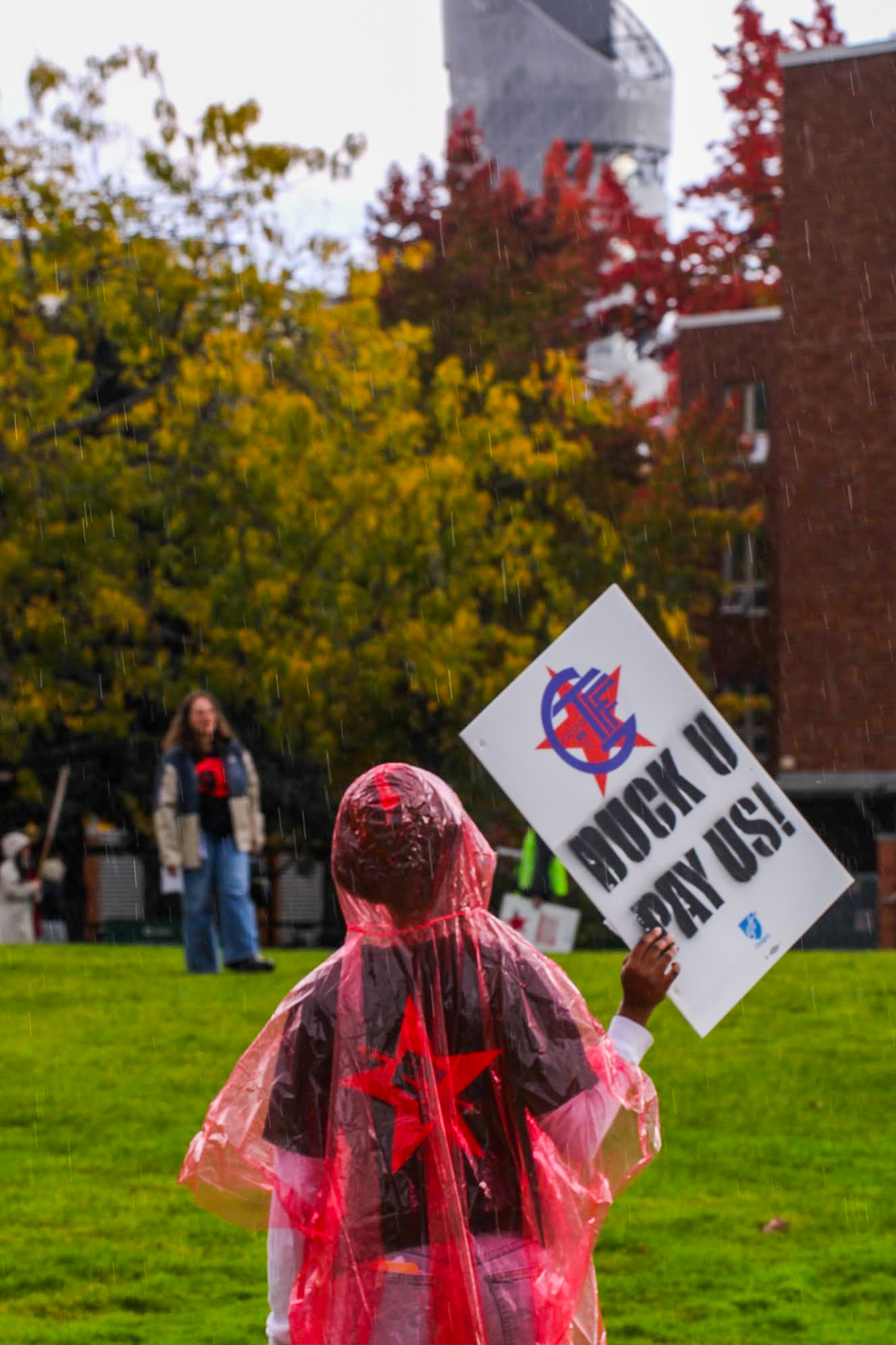
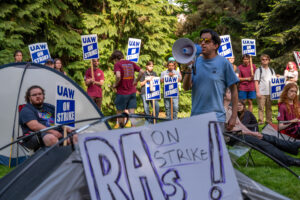
In the same breath, we see the four campus unions pushed, always, to strike: SEIU got a tentative agreement just six hours before go time, and the Graduate Teaching Fellows Federation (GTFF) set to follow suit by Nov. 9, locked in a contract fight with an administration they argue is engaging in illegal “surface bargaining.” (In 2025, the faculty-representing United Academics were close to a strike of their own, and the UO Student Workers bargaining their first contract that same year went on a historically militant 10-day strike).


From here, it’s up to us
The particulars of state legislation, billion dollar donations and budget cuts may be complex, but the bottom line is quite simple: the ruling class, best represented by Phil Knight, has dominated the University of Oregon to the point that they dictate both its internal operations and how it relates to the broader world around it.
The public university has become another tool for the ruling class to shape the future for themselves, ruthlessly exploiting anyone seeking to learn or work. And the administrators, for their part, have paid themselves as much as possible while delivering on elite wishes to hollow out the liberal arts and deny workers fair pay.
We might take this account and say the neoliberal university is in crisis. But truly, to echo Shana Redmond, the neoliberal university is the crisis.
Within the spiraling of its history, different forces have acted upon the university for different interests, but the wreckage they’ve accumulated is stacked upon the same truth: capitalism continues to find new frontiers to exploit, and we are the collateral.
But, as we’ve learned from the people who have—at times—shown a capacity to resist these advances, Phil Knight’s future does not have to be our own. An analysis shared by those inside and around the institution is a step towards breaking it open, tearing it down and building something new.



Be First to Comment