Editor’s note: Last year, I was the elected communications committee chair of UOSW-UAW Local 8121’s executive body. I did not run for re-election, but I remain a rank-and-file member of my union.
EUGENE, Ore., Sept. 27 — The University of Oregon says it will reassign student workers to units that stay open during a strike by SEIU Local 503, and internal emails show administrators are recruiting volunteers to staff dining halls. The strike is set to begin at 6 a.m. Monday, Sept. 28.
Student workers in University Catering, where all events for the week of Sept. 28 have been canceled, are being scheduled to work in dining units instead. In a Sept. 23 message sent through WhenToWork and obtained by The Knightly Ruby, catering operations manager Steve Patterson told staff the union “has declared their intent to strike” and that feeding students on meal plans is “the highest priority for UO Dining Services.”
Patterson acknowledged the shift is unwelcome. “I understand that helping in the dining units is not preferred, but it is important,” he wrote. He said dining staff had come to catering this week to fill gaps, and that catering workers now “have the opportunity to help fill their gaps next week.”
“Filling gaps” has reached beyond students.
On Sept. 18, Deborah Butler, associate vice president for campus services and chief of staff, emailed a list of chiefs of staff on behalf of Derek Kindle, vice president for student services and enrollment management; Jamie Moffitt, senior vice president for finance and administration; and Provost Christopher Long.
Citing “contingency planning for a possible SEIU strike,” Butler’s message encouraged officers of administration, who are non-union employees often in management and supervisory roles, to “volunteer for dining shifts to provide coverage if SEIU goes on strike.” Hours worked would count as time worked, and non-exempt officers would be paid.
On Sept. 24, Vice President for Advancement Joseph Buck sent a similar request to an Advancement staff list, obtained by the Ruby. “We have important work to do, and we have to make sure that our students are fed,” he wrote.
A day after Patterson’s message said workers “are being scheduled” in dining units, spokesperson Angela Seydel responded in a Sept. 24 statement to the Ruby’s written questions about whether student workers had been moved from their regular workplaces to higher-priority units: “Dining has not changed any students’ regular schedules due to a potential strike however, in the event of a strike, we are reassigning students who would normally work in venues that will be closed due to the strike to units that will be operating during the strike.”
Seydel did not answer whether general counsel—UO’s legal apparatus—was consulted on strike staffing, whether the university believes the reassignments fall within Article 1, Section 2 of UOSW’s contract, whether students are being told that shifts offered or required fall during a potential strike or whether UO has renewed temporary postings in SEIU-represented units in the last 30 days.
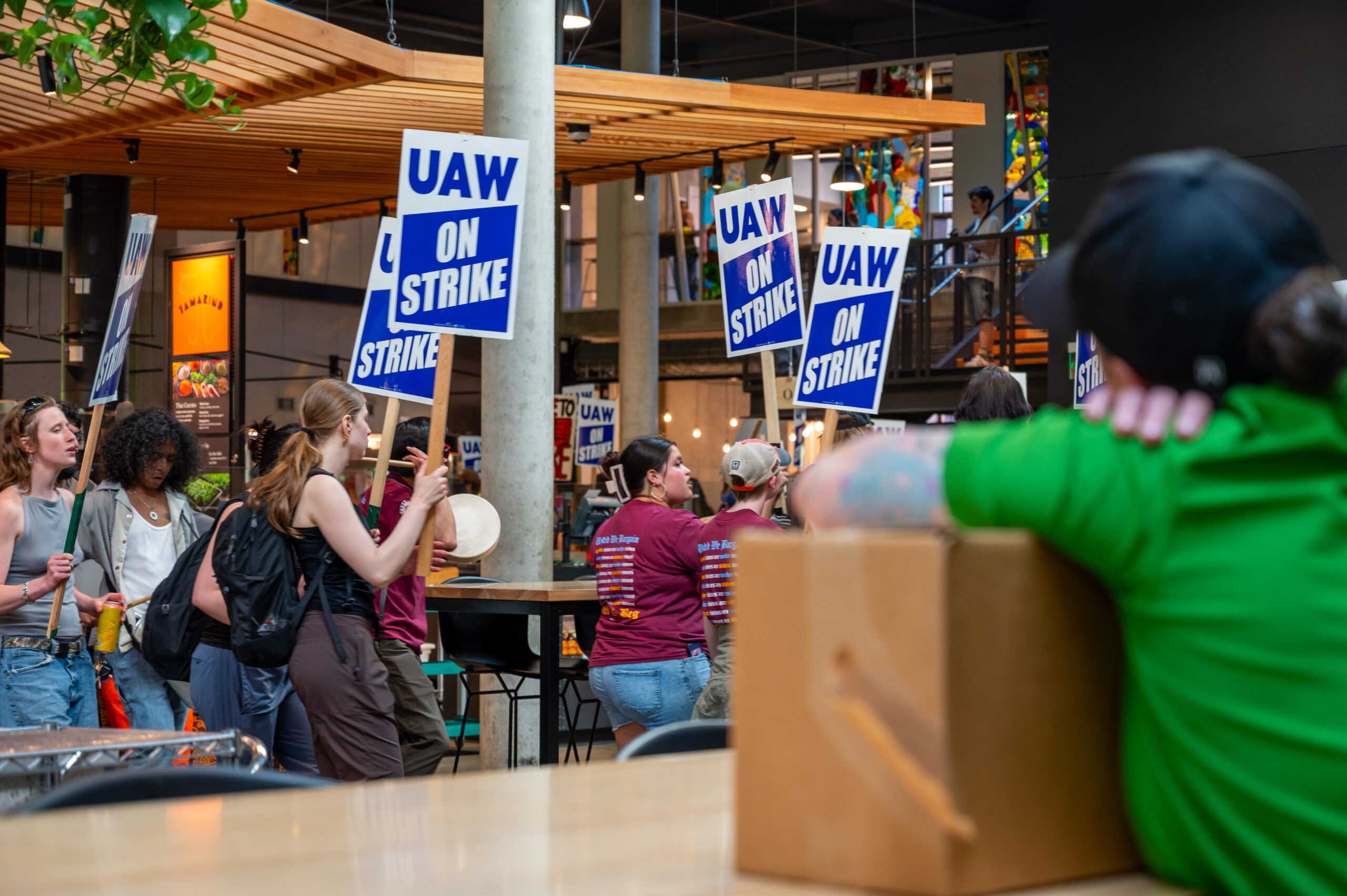
Zero Waste program manager Phil Chesbro also emailed staff on or before Sept. 23, saying the “custodial team asked for additional help starting next week” and offering shifts from 5:30 to 10 p.m. under custodial supervisors. The email obtained by the Ruby does not mention the strike. Asked about it, Campus Planning and Facilities Management director Kevin Farthing, Chesbro’s supervisor, referred the Ruby to Molly Blancett, assistant director for news operations, who did not respond by publication.
UOSW supports work-to-rule
Kellan Murakami, UO Student Workers trustee, said in a statement to the Ruby: “UOSW condemns the practice of asking workers in other campus unions to cover the shifts of striking workers. If UO is attempting to exploit the lack of contractual protections against crossing picket lines, it is an attempt to lessen the threat of an SEIU strike: an attempt which will not succeed.”
“Upper admin know that the university cannot function without SEIU labor,” Murakami said, “but instead of capitulating to bargaining demands and giving their laborers the contract they deserve, they would choose to try to replace their labor.”
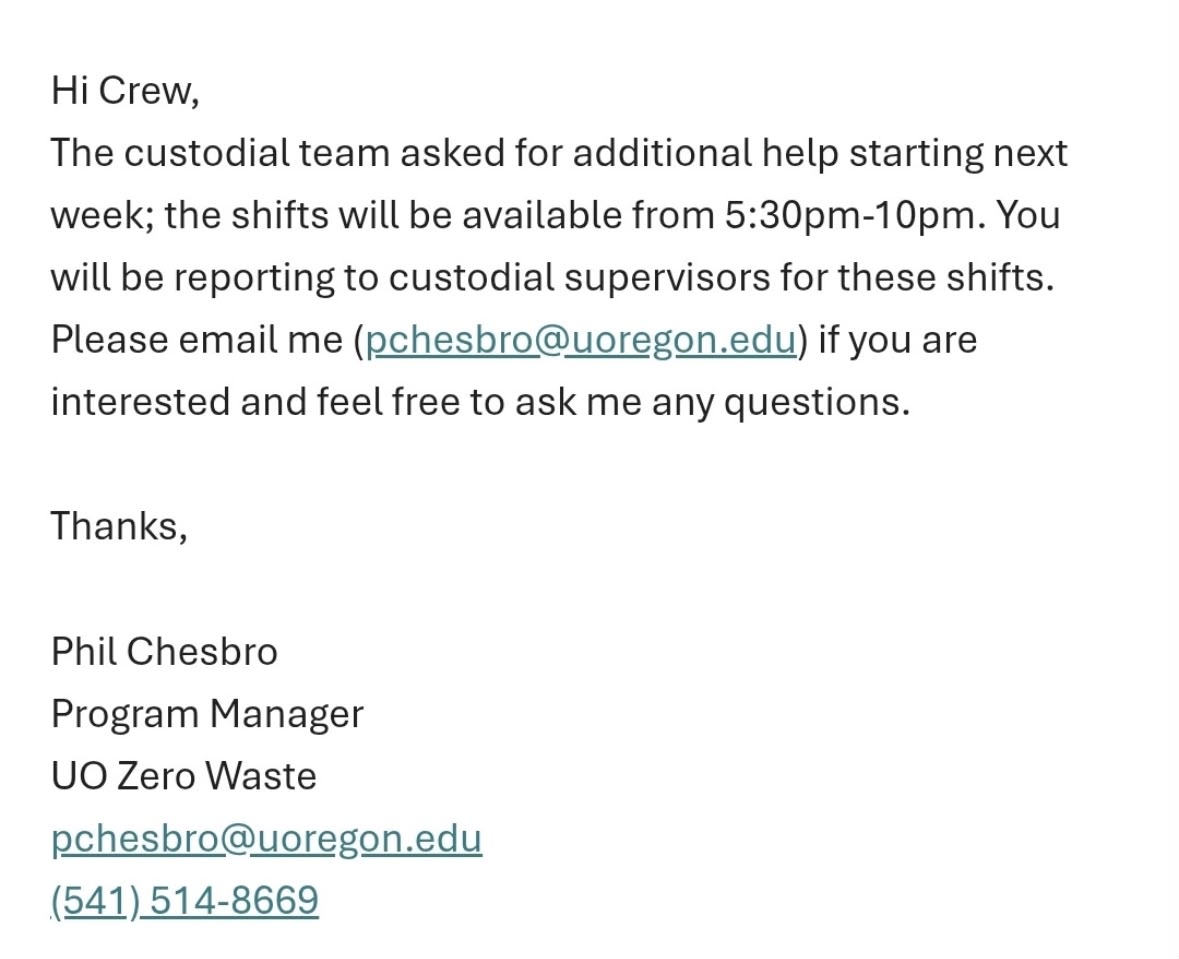
Murakami said UOSW supports work-to-rule, in which workers follow every work rule to its letter—nothing more, nothing less—and refuse to pick up shifts of striking workers. “Our solidarity with SEIU now will be shown in turn by SEIU in the event of a 2028 UOSW strike,” she said.
United Academics, the faculty union, and the Graduate Teaching Fellows Federation, which is in bargaining, have contract language protecting their members from being required to perform struck work in Articles 41 and Sections 2 of their respective contracts. SEIU and UOSW do not.
Catering workers have pushed back before
Last fall, catering workers tried to deliver a letter (see below) to assistant director of catering Alicia Spitzer demanding they not be required to work dining units. The department later made those shifts opt-in, according to former catering worker and UO alum Jace Deninger, though he said the change likely had another cause.
A Duck’s guide to SEIU on strike
SEIU Local 503’s Higher Education bargaining unit, which includes classified staff at UO, is striking after 97 percent of members voted to authorize it in balloting Sept. 14-16, according to a union strike manual. The union’s UO chapter, Sub-Local 085, represents classified staff including dining and custodial workers, roughly 1,500 employees in all. The manual says the union issued a 10-day strike notice to the universities Aug. 18 and that members will strike “until we win.”
The union declared impasse Aug. 7 and submitted its final offer Aug. 14: a 3 percent base wage increase effective July 1, tied to future cost-of-living adjustments based on the consumer price index. The university system’s Aug. 10 counterproposal included no raise for the rest of 2026, a 1 percent increase Jan. 1, 2027, and a 0.5 percent increase a year later, plus a step freeze from July 2027 to June 2028, according to a table published by SEIU. The union also says management is seeking to end layoff bumping rights, drop feasibility studies that guard against contracting out, and remove the guaranteed 97-3 percent health insurance premium split on low-cost plans.
In the manual, the union cites a bargaining survey in which 54 percent of members said they worry about running out of money before their next paycheck and 28 percent said they are going into debt for basic living expenses. It says spending on administration at the universities has grown by $161 million over the past decade.
SEIU has authorized strike pay of $80 a day, up to $400 a week and moved $500,000 into a hardship fund.
The union did not submit a statement to the Ruby’s questions by publication.





Be First to Comment