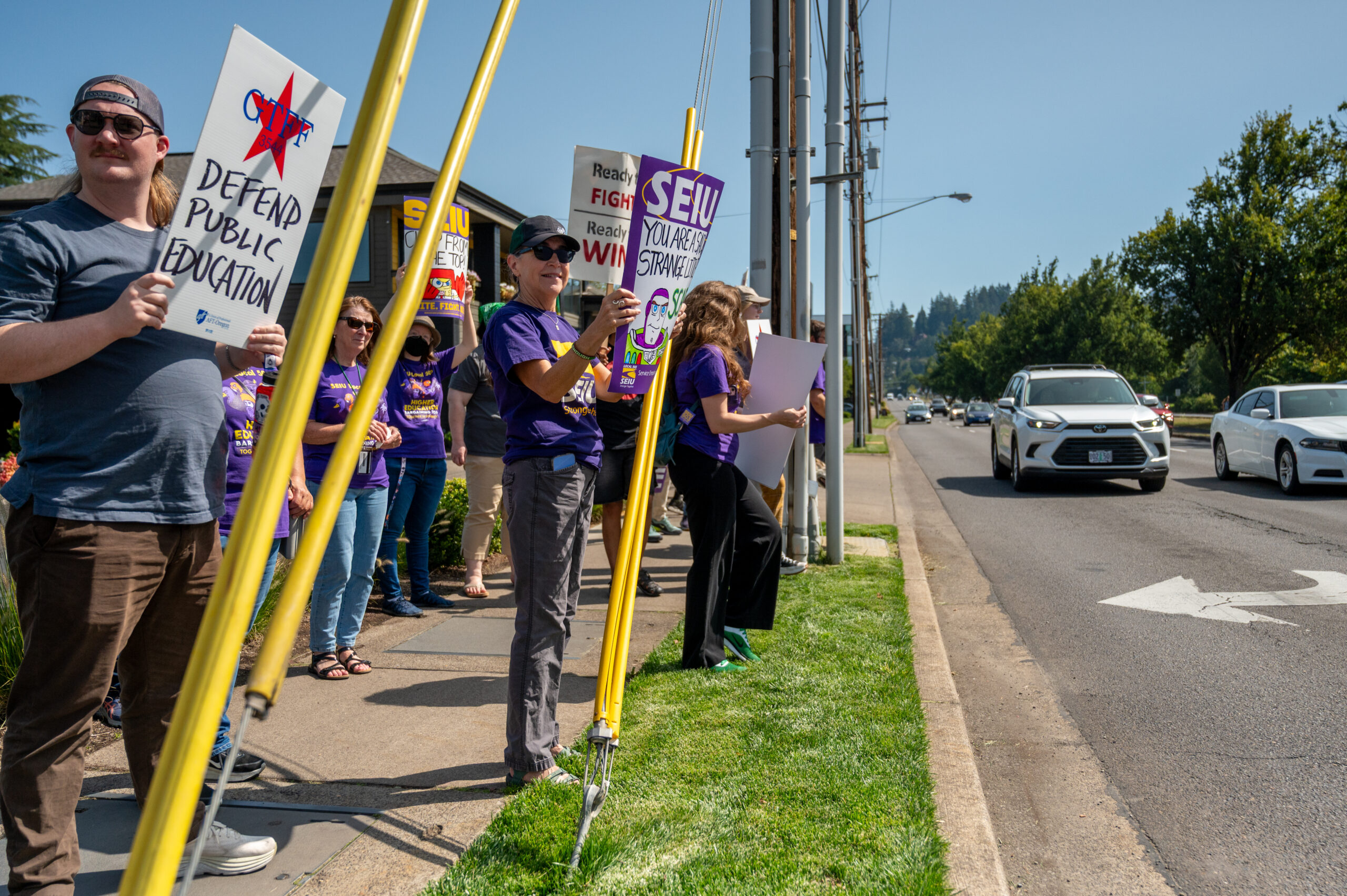
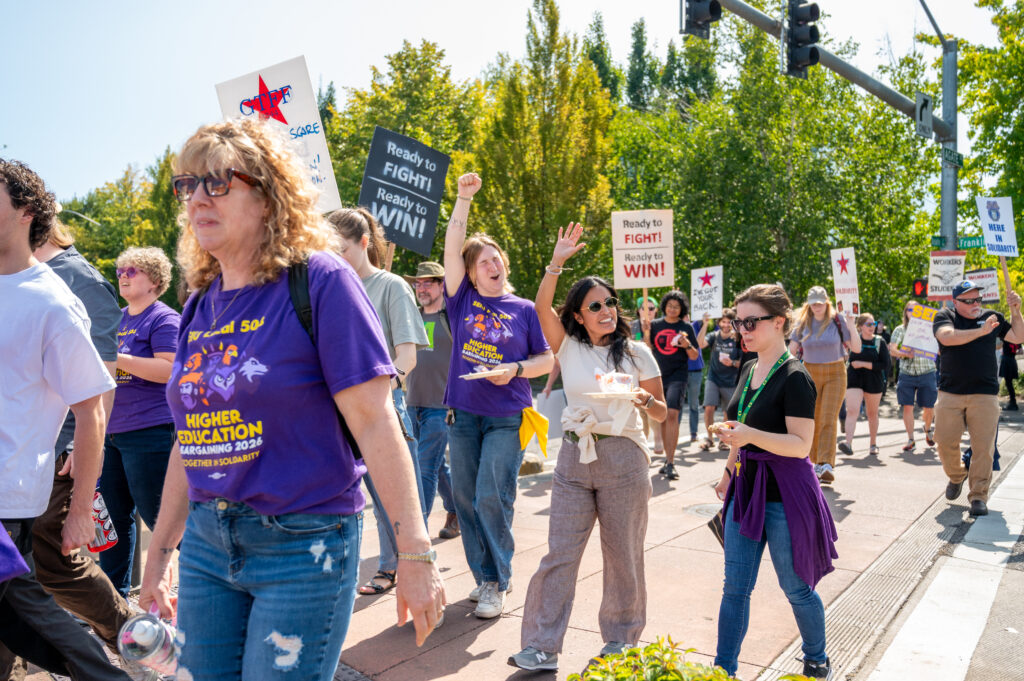
EUGENE, Ore., Sept. 11 — SEIU 503-085 took to the streets yesterday in a joint rally with the graduate employee union—squaring off the intersection at Franklin and Agate—in the furthest action Local 503 has taken toward a statewide strike since the administration buckled last minute in 2019.
On Monday, they’ll vote whether to strike.
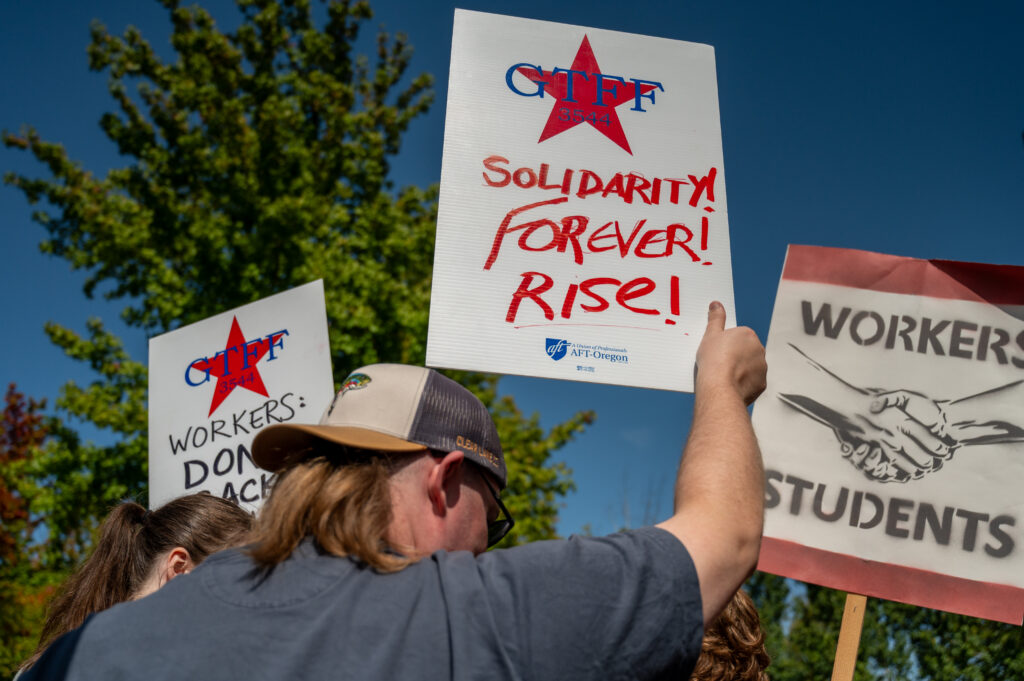
‘We work, we sweat—put that COLA on our checks!’
In SEIU’s final Aug. 14 offer after declaring impasse the week before, they seek a three percent base wage increase effective July 1, tied to future cost-of-living adjustments averaged via consumer price index—aka, how the state measures inflation.
The university system’s Aug. 10 counterproposal included no wage increase for the remainder of 2026—just a one percent bump starting Jan. 1, 2027, followed by a 0.5 percent a year later.
| Priority | Management proposals | Union proposals |
| Economics | • January 1, 2027 wage increase: 1% • January 1, 2028 wage increase: 0.5% • Step freeze from 7/2027-6/2028 | • July 1, 2026 wage increase: CPI (not less than 3% total). • July 1, 2027 wage increase: CPI + 1.5% (not less than 3% total). • Increase longevity premium to an additional 1% for every 5 years of service. |
| Union Power | • Eliminate your right to bump if you are laid off • Remove feasibility studies, one of our core protections against contracting out our jobs • Union orientations for all new employees within the first 30 days of hire [in agreement] | • Safeguard bumping rights in layoff and feasibility studies for contracting out • Union orientations for all new employees within the first 30 days of hire [in agreement] |
| Benefits | • Remove guaranteed 97%/3% health insurance split for low cost plans | • Maintaining healthcare benefits is a top priority |
| Employee Protections | • “No” to improving inclement weather leave • “No” to protecting immigrant workers | • Improve access to inclement weather leave • Protect immigrant workers |
Sublocal 085 president and city councilwoman Jen Smith pointed to the 4.4 percent rise in inflation from May 2025 to 2026, a month before SEIU’s contract expired.
“The disrespect (by UO’s bargaining team) is tangible,” Smith said. “Especially if you’ve been at this campus for multiple years; you feel like you’ve found a home here. You care deeply about the students and serving the faculty. These are the real features of this job—I mean, we’re not in it for the money.”
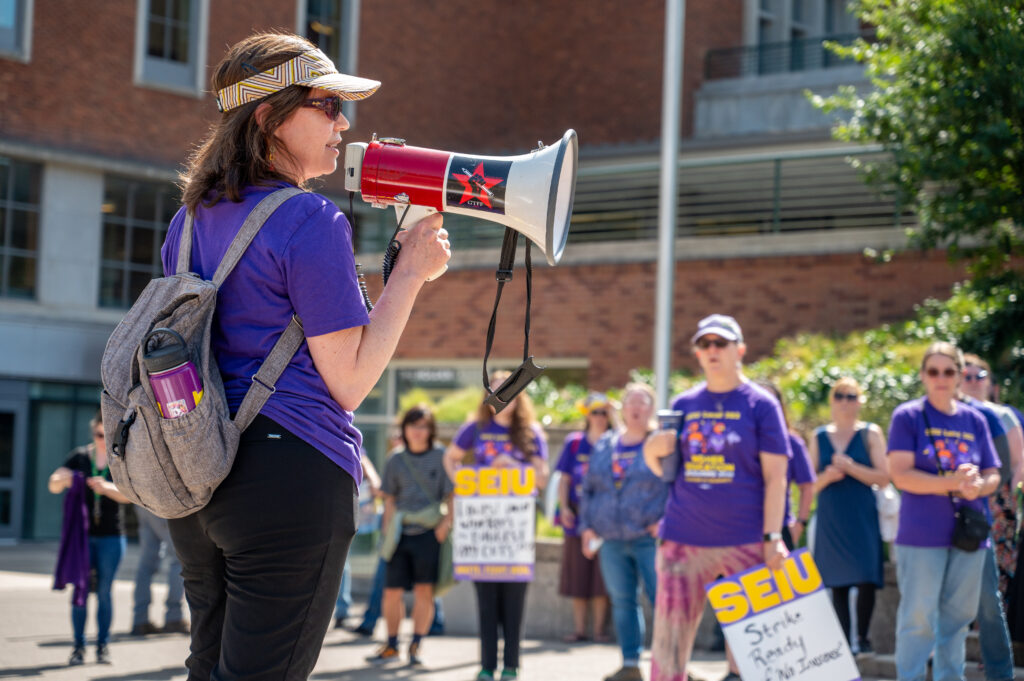
‘Chop from the top!’
“We’re at war (with admin) right now on campus when we should be working together to achieve our common goals, and this ain’t it,” Smith said. “I mean, they expect us to just crawl to this campus at some point and go to the food bank after work. And that’s fine with them.”
UO ranks tenth in a list of employers named most often on applications for SNAP benefits, the Capital Chronicle found. Oregon State University tops it at sixth place.


Smith acknowledged workers’ worries about striking. “(But) think of yourself in a year, when they’re doing layoffs—and you don’t have any layoff protections. (Admin) is contracting your job out and you’re on the street. That’s our union: they’re trying to bust our union,” she said.
“Strikes are a sacrifice,” Smith said. “But it’s like going to college. You live in poverty, and you scramble, and you scrape, and you stress because you’re thinking that this is going to be a pathway to having a more prosperous future where you have a little bit more control over your life.”
In an August white paper, SEIU found that administrators account for at least $510 million in salary spending across Oregon’s seven public universities, against $292 million for classified staff—or $1.75 spent on admin for every dollar spent on the workers who keep campuses running.
“(Admin) has been captured by this business mentality that the public good is only there to make sure that the books are evening out—and there’s not enough state support,” Smith said. “We should be working together to get legislators to give us more money.”

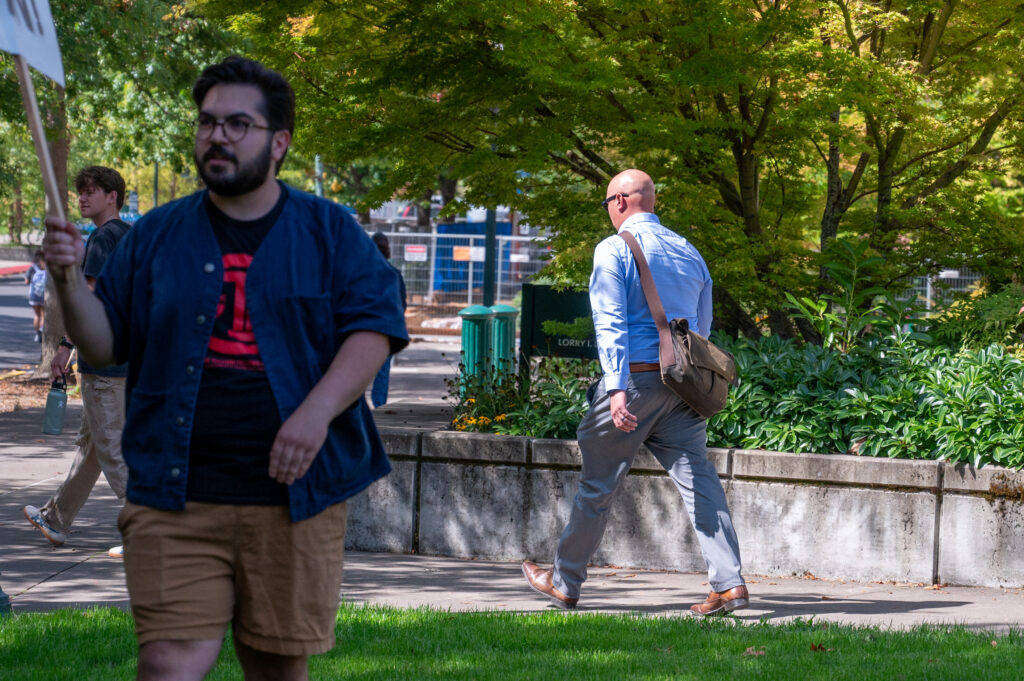
At the very top: UO President John Karl Scholz’s contract guarantees his base salary rises from $725,000 to $816,000 by 2027-28, a 12.6 percent increase locked in regardless of the university’s financial condition, plus a $150,000 annual retirement contribution, two possible $100,000 retention bonuses, room and board at the McMorran House and a monthly vehicle stipend.
What Scholz is guaranteed amounts to more than the entire wage increase UO’s bargaining team has offered classified staff through 2028—which, for the rest of this year, would start at 0 percent.
“We’re going to be suffering either short-term now or long-term later if we don’t stick together,” Smith said. “The only agency we have is collective agency. And once you feel it, there’s nothing as powerful or as affirming.”


Cooper Giroux contributed research to this article.





Be First to Comment